
How Abuse Shows Up in Roommate/Non-romantic Cohabitation Relationships
Note: This page will use the term “roommate” to describe anyone you live with in any capacity, not just someone with whom you share a literal room (a.k.a. “Housemates,” “flatmates,” “apartment-mates”). This document only applies to roommates who have at no point been romantically involved. Domestic/intimate partner violence resources are available at thehotline.org.
Note: There is a wide range of types of roommate problems that all fall along a spectrum of severity. For the purpose of this document, we are referring to situations in which a roommate makes another roommate feel emotionally or physically unsafe. Often people dismiss roommate problems as a rite of passage or merely a small annoyance. It is important to acknowledge that roommate problems can, and commonly do, go beyond this level of severity. It is also important to trust yourself and your experience in your situation. The same situation can have a different emotional effect depending on the person, so for the purpose of this website, consider how you feel rather than relying on formal definitions of abuse and harassment.
Power imbalances in roommate situations:
Power imbalances can show up in roommate relationships in a variety of ways, including the following non-exhaustive list of examples. It is important to note that the existence alone of these power differences is not the problem. In most relationships people differ in power in one way or another. These differences in power become problematic when one person or group uses the power difference to harm the other person or group. Abuse can be perpetrated not only by the person in the higher power position, but also by the person in the lower power position. For example, sometimes people use their position of lower power in one respect to insist that the person of higher power unreasonably owes them something like money or extra chores.
A few possible types of roommate power imbalances:
- Group vs. individual
- E.g., an individual moves in with two strangers who have been close friends with each other for years.
- Couple vs. individual
- An individual moves in with people who are dating or married
- On the lease vs. subtenant
- One or more residents are either signed or unsigned subtenants.
- Differences in amount of rent paid/space occupied
- Rent is not equally split and/or space is not equally split.
- Differences in how long the parties have lived in the current residence
- E.g., an individual moves into an apartment with housemates who have been living there for years.
- Differences in age
- E.g., an undergraduate first-year moves in with a graduate student.
- Differences in relationship to the landlord
- E.g., the landlord is a family member or friend of one tenant but not another.
- Differences in identity of any sort (including but not limited to race, gender, sexual orientation, class, religion)
- Identity can be used to manipulate someone.
- Identity can also affect comfort reporting to police/authorities
- Stereotypes in society affect who is seen as a perpetrator and who is seen as a victim (e.g. an assumption that perpetrator is a straight male and survivor/victim is a straight White female)
Power and Control:
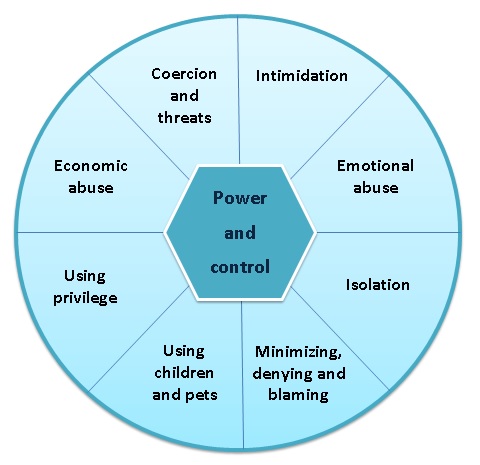
Abuse centers on power, control, and consent. The following image (based on the Duluth Model’s Power and Control Wheel) lists some ways in which one person can attempt to gain power and control over another. A behavior alone is not always enough to determine if something is abuse, because consent is also key. For example, there is a difference between entering your roommate’s room with their permission to watch a movie together and sleeping in their bed when they are gone and they told you to stay out of their room.
Types of Abuse/Harassment and Roommate-specific Examples:
Physical:
- Controlling your access to the living space (e.g. taking your keys, locking you out)
- Any sort of physical violence against you, your children and/or your pets
- Throwing/breaking things (even if you are not physically harmed, this behavior serves to intimidate and tends to send the message that you will be next)
Emotional:
- Silent treatment/refusing to talk to you about a disagreement for an unreasonable amount of time
- Isolating you from your friends, family, other roommates (e.g., turning other roommates against you)
- Gaslighting (i.e., making you doubt your perception/reality)
- Denying things you know are true (even if you have indisputable proof)
- Telling you that you are overly sensitive/trivializing your concerns
- Turning the situation around and blaming you when you call them out/try to have a conversation about their behavior
- Telling you that you are causing the abuse/that they wouldn’t have done x if you hadn’t done y
Economic/Financial:
- Refusing to pay rent unless you do something/behave in a specific way
- Forcing you to pay more than your share of the rent
Verbal:
- Threats (e.g. to hurt you, your children, or your pets)
- Insults/name-calling
Digital/Technological:
- Recording you without your consent/placing cameras in the living space without your consent
- Demanding that you share your location via your phone against your wishes
Other:
- Making or threatening to make false claims about you to your landlord or another authority
- Turning other housemates against you in order to control you
“Why Don’t You Just Move Out?”
Similar to the common lack of understanding around why people stay in abusive romantic relationships, one might say, “Why don’t you just move out?” There are a variety of understandable reasons for staying in a hostile roommate situation and it is important to note that “just moving out” isn’t feasible, or even safe, for everyone. Below is a non-exhaustive list of reasons someone might stay in a hostile living situation:
- Lack of financial means to break a lease and/or pay for another place (can be caused or intensified by economic abuse)
- The current housing situation may be the only affordable and available place in the area, breaking the lease might be too expensive, the individual might not be able to afford a hotel/Airbnb
- Roommates may also sabotage attempts to find a subletter/replacement roommate, (e.g. refusing all subletters, lying to subletters, not signing off when the lease requires all tenants to sign off on subletters) adding to financial burden on the roommate trying to move out
- Lack of social support (which can be caused or intensified by isolation by the roommate) can make moving in with friends or family not an option.
- Positive memories with the person and/or hoping that the relationship can be repaired
- Guilt
- E.g., feeling guilty about leaving the roommate(s) with a subletter, worrying that moving out will hurt the roommate(s)’ feelings (often intensified by roommate’s manipulative tactics)
- Low self-esteem
- E.g., feelings that the treatment by the roommate(s) is justified (again, often brought on and/or intensified by roommate’s manipulative tactics)
- Doubt about one’s experience of abuse because, for example, some days are better than others, because they have been manipulated into feeling like they are overreacting, or because the types of abuse they are experiencing are not commonly talked about
- Fear that leaving could make the abuse worse/fear of retaliation by roommate
Mediation/Counseling and Abusive Behavior
In some situations, mediation, whether formal or informal, can be helpful, but it is important to acknowledge that under some circumstances, mediation can do more harm than good. This article, this article, and this article provide good explanations of this concept from the domestic violence perspective. Simply put, mediation often approaches a situation from the perspective that both parties play a role in maintaining the state of conflict and thus must focus on coming to a compromise. However, in situations of abuse, this assumption does not hold because one person is exerting power and control over the other person. It is especially common in roommate situations, which can vary so greatly in severity, for people to assume that any conflict with a roommate is a minor disagreement that can be solved with a talk or mediation.
What if I Just Can’t Move Out?: Safety Planning
Sometimes even when people want to leave an abusive living situation, it isn’t feasible. Safety planning can help protect your physical and emotional safety even if you can’t leave the situation.
- Safety planning ideas (thinking about how you can mitigate risk):
- Is there a place you can go to get away from them/somewhere that can be a safe place?
- How can you stay connected to support?
- Includes thinking of resources, but also finding a place to safely access resources that require talking on the phone, viewing a website, etc.
- VA Intimate Intimate Partner Violence Safety Planning Resource (not specific to roommates, but the concepts still apply.)
Mental Health Impact and Resources
Roommate abuse can have a significant impact on mental health. Although roommate abuse in particular is not often talked about, the effects of abuse in general are well-documented and include but are not limited to depression, anxiety, PTSD, low self-esteem, self-harm, and suicidal ideation. The home is often thought of as a safe place to come back to after the stresses of the day, so it is understandable that not having that feeling of safety can take a toll on people. Lastly, what makes one feel emotionally or physically unsafe differs from person to person and it is important to understand that your experience is valid, even if your roommate says otherwise and/or others don’t seem to understand. Whether or not you end up moving out, mental health resources are there to support you through the process of living with the roommate and recovering from the experience afterwards.
Managing Future Roommate Situations
Given the mental health impact of roommate problems, it can be hard to imagine living with people again after a difficult situation. However, for many people, living with roommates is their only option. Having a roommate agreement in place does not prevent abuse, however some survivors find it an empowering way to express their needs and boundaries. If this feels helpful, below is an example roommate agreement. However, it is also important to note that that abuse is never okay. Not having a roommate agreement, etc. in your current situation absolutely does not excuse your roommate’s behavior or make the abuse your fault.
 RoommateAbuse.org